Proceeding from the central altar you can see: the “Deposition” ” (1551 or 1571),

THIS SIGNED WORK BY SILVESTRO BUONO SHOWS, AT LOWER LEFT, A PORTRAIT OF A GENTLEMAN IN PERIOD DRESS, PROBABLY GIAN GIACOMO SPATAFORA, MAYOR OF AVELLINO, WHO MAY HAVE BEEN REWARDED FOR DONATING LAND TO BUILD THE CHURCH AND CONVENT
Madonna delle Grazie’, ‘San Gennaro’ and ‘San Francesco’ (around 1584) by Silvestro Buono, in the altar triptych.

The lunettes by Nicola Malinconico (not later than 1727) can be seen further on.


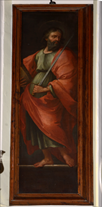
superb figures by Francesco Solimena representing ‘St Peter’ on the right and ‘St Paul’ on the left, circa 1702

The ovals of the ‘Mysteries’ in the nave are presumably by Teresa Palomba (‘Presentation in the Temple’, ‘Visitation’ and ‘Pentecost’ on the left; ‘Assumption’, ‘Descent of the Holy Spirit’ and ‘Annunciation’ on the right), dated no later than 1748.


Particular attention should be paid to the small painting of the “Madonna Appearing to San Felice” (a work attributed to Nicola Vaccaro, who is said to have replicated, according to his own documentary evidence, a similar painting made by his father for the church of San Pietro ad Aram in Naples, commissioned by the Muzio Spadafora family, whose coat of arms and the figure of Donna Maria Antonia Ruffo, Spadafora’s wife, are depicted in the Avellino painting).
On the ceiling, however, proceeding from the high altar towards the nave, the Apparition of the Virgin to St Francis and St Felix of Cantalice’ (by Michele Ricciardi, mid-18th century),

the Adoration of the Magi (by an unknown artist, copied from Pietro Negroni), the worst preserved painting in the collection, which is, however, highly representative of early 17th-century Counter-Reformation mannerism in the South.

The Embrace of Saint Felix and Saint Philip Neri” and “The Embrace of Saint Dominic and Saint Francis”, both by Michele Ricciardi (first half of the 18th century).


IN THE CANVAS DEPICTING THE EMBRACE OF SAINT FELICE WITH SAINT FILIPPO NERI WE CAN RECALL THAT IT WAS COMMON IN 16TH CENTURY ROME TO WITNESS THE CURSES THAT THE TWO RELIGIOUS EXCHANGED WHEN THEY MET DURING THE QUEST. “ONLY WHEN A LARGE CROWD OF PEOPLE HAD GATHERED, INTRIGUED BY THE EXCHANGE OF CURSES, WOULD THEY CONCLUDE WITH “MAY YOU SUFFER THIS FOR THE LOVE OF GOD” AND EMBRACE EACH OTHER, IN THIS WAY, AND HOLY CARDS AND PRINTS HAVE ALWAYS BEEN CIRCULATING ON THIS EPISODE.
The “pearl” of the paintings on display in the ceiling is the splendid altarpiece of the Apparition of the Virgin to Saint Felix of Cantalice by Francesco Guarino (c. 1650).

In the convent, we have the valuable “Escape to Egypt”. Justified on the basis of chronological, stylistic and documentary concordances, it is attributed to Teresa Palomba (mid-18th century).

Mention should also be made of L’Immagine di Padre Pio’ (2015) and ‘Cenacolo’ (1965) by Pio Barzaghi and L’Annunciazione’ (i983) by Antonio Festa,


There is a valuable polychrome wooden statue of “St Francis of Assisi” attributed to Giuseppe Picano (late 17th – early 18th century) (see location).
The twenty terracotta high-reliefs (lunettes) in the cloister of the monastery are interesting. Inspired by Franciscan themes, they were made in 1968 by Giulio Catelli, an original and imaginative Camaldolese sculptor who has yet to be discovered.
Source : Prof. Riccardo Sica
Source: Re-elaboration of article on Giornaleirpinia.it
